Table of Contents
- Why Pull-Ups Are the Benchmark of Upper Body Strength
- Weeks 1–2: Build the Foundation with Negatives
- Weeks 3–4: Introduce Assisted Reps and Isometric Holds
- Weeks 5–6: Increase Volume with Cluster Sets
- Weeks 7–8: Consolidate and Push Toward Ten Reps
- Common Mistakes and How to Fix Them
- Programming Rest and Recovery
- Frequently Asked Questions
- Start Today
- Related Articles
Key Takeaways
- Start with negative reps and scapular retractions if you cannot do a single pull-up.
- Use resistance bands and isometric holds to bridge the gap from zero to a few reps.
- Cluster sets and descending ladders are effective for accumulating volume without burnout.
- Rest 48 hours between sessions and prioritize scapular control to avoid injury.
- By week 8, you should be able to perform 10 consecutive strict pull-ups with proper form.
Why Pull-Ups Are the Benchmark of Upper Body Strength
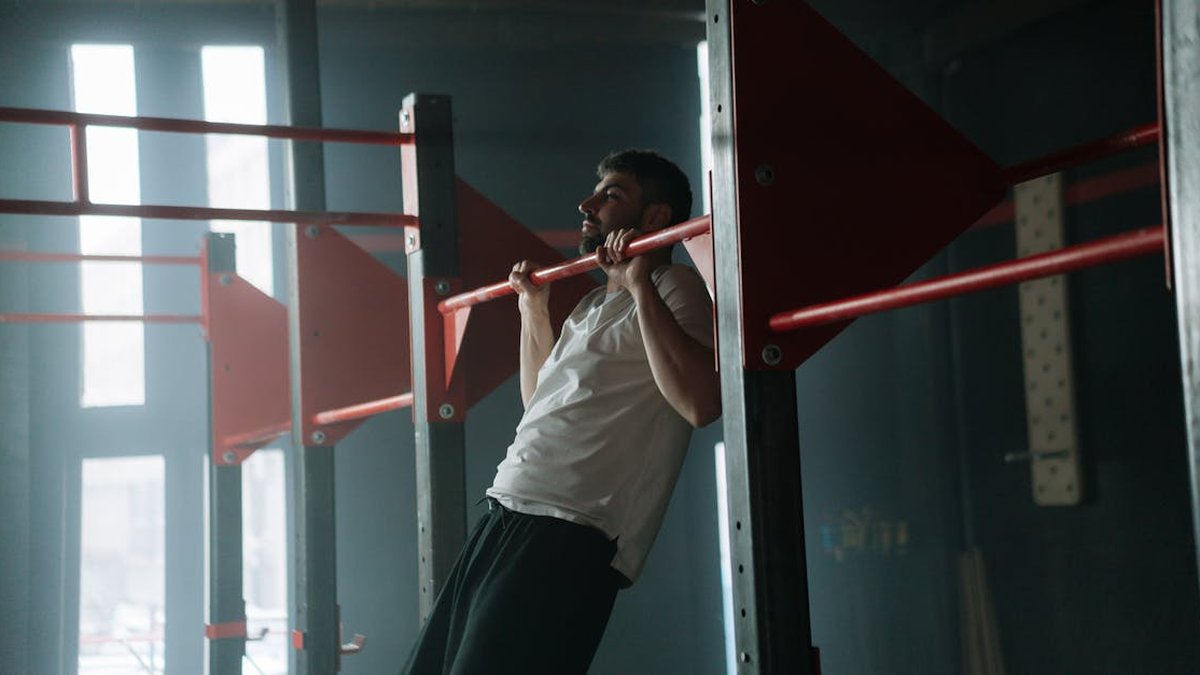
The pull-up is a closed-chain compound movement that recruits the latissimus dorsi, biceps brachii, rhomboids, and core stabilizers. Unlike machine-based lat pulldowns, pull-ups require full-body tension and scapular control. A 2022 study in the Journal of Strength and Conditioning Research found that individuals who could perform at least ten strict pull-ups had 34% greater relative upper body strength than those who could not.
This plan is designed for absolute beginners. You do not need prior pull-up ability. The only prerequisites are a sturdy pull-up bar, three sessions per week, and a willingness to follow the prescribed volume and rest intervals. Each week builds on the previous one using progressive overload and specific tempo work.
Before starting, test your current max. If you cannot do one full pull-up, begin with the negative-phase emphasis in weeks 1–2. If you can do 1–3 reps, start at week 3. Record your max after week 8 to measure progress.
Weeks 1–2: Build the Foundation with Negatives
During the first two weeks, your goal is to strengthen the eccentric (lowering) phase. Research shows that eccentric overload produces greater hypertrophy and strength gains in the lats and biceps than concentric-only work. Perform each rep with a controlled 5-second descent.
Workout A (Mon/Fri): 5 sets of 3–5 negative reps. Jump or step up to the top position (chin over bar), then lower yourself as slowly as possible for 5 seconds. Rest 90 seconds between sets. Workout B (Wed): 3 sets of max hanging scapular retractions. Hang from the bar with arms straight, then pull your shoulder blades down and together without bending your elbows. Hold each retraction for 3 seconds. Do 8–12 reps per set.
Total weekly volume: 30–50 negatives. If you cannot complete the 5-second descent, reduce to 3 seconds and increase by 1 second each session. Avoid kipping or swinging—control is everything.
Weeks 3–4: Introduce Assisted Reps and Isometric Holds
Now you will add assisted repetitions using resistance bands looped over the bar. Choose a band that allows you to complete 3–5 slow, controlled reps with good form. The band should reduce your bodyweight by approximately 30–40%.
Workout A: 4 sets of band-assisted pull-ups. Perform 5 reps per set with a 3-second concentric (pull-up) and 3-second eccentric. Rest 2 minutes between sets. Workout B: 3 sets of isometric holds at the top position. Jump to the top, hold for 5–10 seconds, then lower for 4 seconds. Do 4–6 holds per set. Workout C: 3 sets of band-assisted pull-ups (5 reps) plus 2 sets of negative reps (3 reps each).
By the end of week 4, you should be able to perform at least 1–2 unassisted reps. If not, continue with the band for one more week before progressing.
Weeks 5–6: Increase Volume with Cluster Sets
Cluster sets involve breaking a set into small mini-sets with short rest intervals. This method allows you to accumulate more total reps without fatiguing to failure. A 2019 meta-analysis in Sports Medicine reported that cluster training improves strength endurance by 18% more than traditional straight sets.
Workout A: 5 clusters of 2 reps each. Rest 15 seconds between each mini-set, then 2 minutes between clusters. Total = 10 reps per workout. Workout B: 4 sets of max-effort singles. Rest 90 seconds between each rep. Aim for 4–6 total singles. Workout C: 3 sets of band-assisted pull-ups (3 reps) followed by 3 sets of negative reps (3 reps each).
Track your reps. If you can complete all clusters without failure, add 1 rep per cluster in week 6. By the end of this phase, you should be performing 5–7 unassisted reps.
Weeks 7–8: Consolidate and Push Toward Ten Reps
The final two weeks focus on converting your strength endurance into a full set of ten consecutive reps. You will use a descending ladder format to build mental and physical tolerance for high-rep work.
Workout A: Ladder sets: perform 1 rep, rest 15 seconds, 2 reps, rest 20 seconds, 3 reps, rest 25 seconds, then reverse: 2 reps, rest 20 seconds, 1 rep. That is one ladder. Do 3 ladders with 3 minutes rest between. Workout B: 3 sets of max reps. Rest 3 minutes between sets. Try to hit at least 8, 7, and 6 reps. Workout C: 5 sets of 3 reps with 2-second pause at the top. Rest 90 seconds between sets.
On your final test day (end of week 8), warm up with 2 sets of 3 reps, rest 3 minutes, then attempt your max set. Most individuals will achieve 10–12 reps. If you hit 10, you have completed the plan. If not, repeat week 8 before moving on.
Common Mistakes and How to Fix Them
Many beginners stall due to grip failure, poor scapular control, or inconsistent rest periods. Use a mixed grip (one palm facing you, one facing away) if your grip gives out before your lats do. Alternatively, use chalk or a towel for grip training.
Scapular retraction is often overlooked. Without pulling your shoulder blades down and back, you rely on your arms instead of your back. Practice the scapular retraction exercise from week 1 as a warm-up before every workout.
Rest intervals matter. Rushing between sets reduces performance. Use a stopwatch and stick to the prescribed rest times. If you skip rest, your central nervous system fatigues faster, and rep quality drops. Finally, do not train to failure every session—leave 1–2 reps in reserve to avoid overtraining and joint strain.
The pull-up is a skill as much as a strength movement. Most people fail because they try to grind through the concentric instead of focusing on the negative and the pause. Control the descent, and the ascent will follow.
Programming Rest and Recovery
Pull-ups place significant stress on the elbows, shoulders, and wrists. Schedule at least 48 hours between pull-up sessions. On off days, perform light mobility work: band pull-aparts (3 sets of 15), doorway pec stretches (30 seconds per side), and wrist circles (10 each direction).
Nutrition plays a role in recovery. Consume 1.6–2.2 grams of protein per kilogram of body weight daily, and prioritize sleep (7–9 hours per night). If you feel elbow pain or clicking in the shoulder, reduce volume by 30% for one week and apply ice after training. Do not ignore sharp pain—consult a professional if it persists.
After completing the 8-week plan, you can maintain your ten-rep max with two sessions per week of 3 sets of 6–8 reps. To progress further, add weight via a dip belt (start with 2.5 kg increments) or switch to weighted pull-ups on a separate day.
Frequently Asked Questions
Common questions about bodyweight training
How many days per week should I train pull-ups?
Three non-consecutive days per week, such as Monday, Wednesday, and Friday. This allows at least 48 hours for muscle recovery and nervous system adaptation.
What if I cannot do a single negative rep without dropping fast?
Use a resistance band to reduce your bodyweight by 40–50%. Focus on a 3-second descent and gradually increase to 5 seconds over two weeks. You can also do band-assisted pull-ups to build strength.
Should I use a pronated or supinated grip?
Start with a pronated (palms facing away) grip for balanced lat and bicep development. A supinated (chin-up) grip shifts more load to the biceps and can be used as a variation after you hit ten reps.
Can I combine this plan with other upper body exercises?
Yes, but avoid heavy pushing exercises (bench press, overhead press) on the same day to prevent shoulder fatigue. Focus on pulling accessories like rows and face pulls on your pull-up days.
Related Articles
Start Today
Eight weeks of consistent, structured pull-up training will take you from zero to ten reps if you follow the progression and respect recovery. The key is patience—each phase is designed to build the specific strength and endurance required for the next. Do not skip weeks or rush the negatives. By the end of this plan, you will have a measurable upper body strength benchmark that few beginners achieve.