Table of Contents
- Why Water Training Works for Every Body
- Aqua Jogging Technique and Programming
- Water Aerobics for Strength and Endurance
- Recovery and Rehabilitation Applications
- Calorie Burn and Metabolic Benefits
- Programming for All Fitness Levels
- Safety and Equipment Essentials
- Frequently Asked Questions
- Start Today
- Related Articles
Key Takeaways
- Aqua jogging and water aerobics eliminate joint impact while providing 12 to 15 times more resistance than air.
- A 30-minute water workout can burn 250–400 calories, with interval protocols boosting metabolism via EPOC.
- Water training effectively supports rehabilitation, reducing chronic lower-back pain by up to 40% over 8 weeks.
- Progress workouts by adding water weights, increasing interval intensity, or extending session duration.
- Beginners should start with 2 weekly sessions of 20–30 minutes; advanced athletes can use water training for active recovery.
Why Water Training Works for Every Body
Water-based exercise removes nearly all joint stress while still challenging your muscles and cardiovascular system. When you submerge to chest depth, buoyancy supports up to 80 percent of your body weight, reducing impact forces to nearly zero. This makes aqua jogging and water aerobics ideal for beginners, older adults, pregnant women, and anyone recovering from injury.
At the same time, water provides 12 to 15 times more resistance than air. Every movement you make becomes a controlled strength exercise without needing external weights. A 30-minute water workout can burn between 250 and 400 calories depending on your intensity and body composition. Whether you are training for a triathlon or just starting an exercise routine, the water adapts to your needs.
Aqua Jogging Technique and Programming
Aqua jogging mimics land running but with zero impact. Wear a flotation belt to keep your head above water and maintain an upright posture. Your arms should swing naturally, and your legs should perform a normal running stride. Do not let your feet touch the pool floor—keep the motion continuous and fluid.
For a beginner session, start with 3 sets of 5 minutes of steady-state aqua jogging, resting 1 minute between sets. As you progress, increase to 10-minute intervals. More advanced athletes can incorporate high-knee drills or backward jogging. A sample intermediate workout: warm up for 5 minutes, then complete 6 x 3-minute intervals at a perceived exertion of 7 out of 10, with 90 seconds of easy jogging between intervals. Cool down for 5 minutes. This protocol improves aerobic capacity without taxing your joints.
Water Aerobics for Strength and Endurance
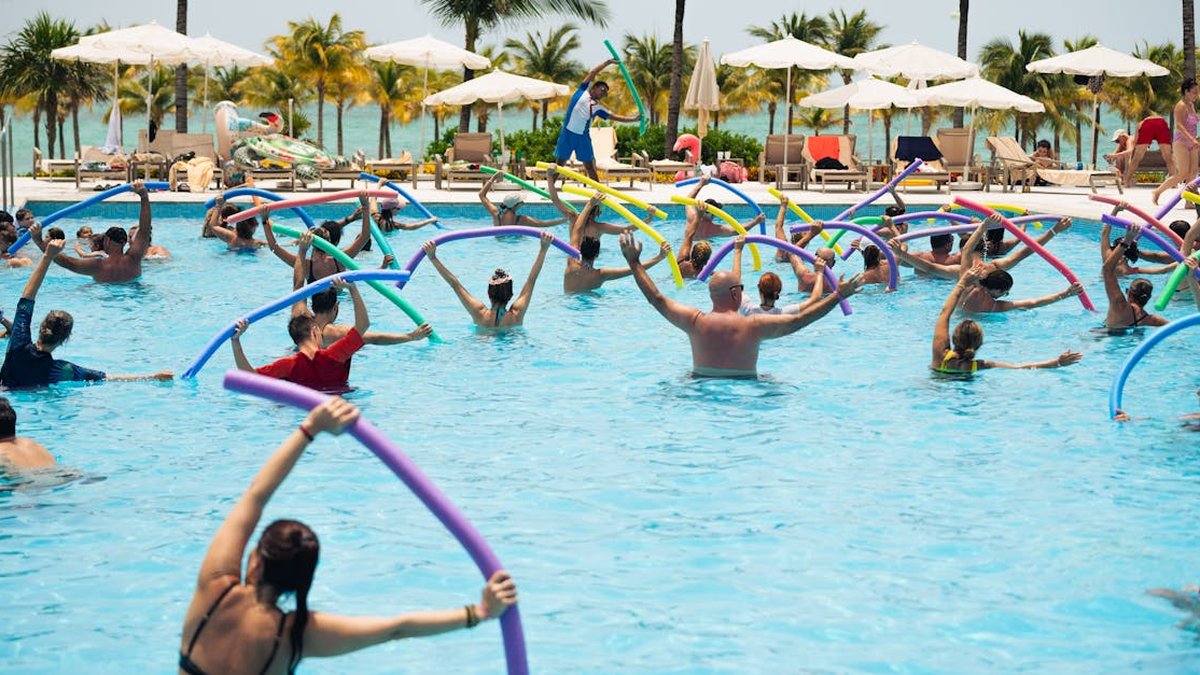
Water aerobics combines rhythmic movements with resistance to build muscle and elevate heart rate. Use the water’s drag to your advantage by performing exercises like water jumping jacks, leg lifts, and arm curls with webbed gloves or paddles. Each movement should be controlled—fast movements increase resistance, slow movements emphasize muscle tension.
A typical 45-minute class structure includes: 5-minute warm-up, 15 minutes of lower-body work (squats, lunges, kicks), 15 minutes of upper-body work (chest presses, lateral raises, triceps extensions), and 10 minutes of core stabilization (standing crunches, torso twists). Aim for 2 to 3 sets of 12 to 15 reps per exercise. Using water dumbbells adds 2 to 5 pounds of resistance per hand, allowing you to progressively overload your muscles safely.
Recovery and Rehabilitation Applications
Physical therapists often prescribe water training for patients recovering from knee surgery, hip replacements, or lower-back injuries. The buoyancy allows for pain-free range-of-motion exercises that would be impossible on land. For example, walking in waist-deep water for 20 minutes at a moderate pace can improve gait mechanics and muscle activation without stressing healing tissues.
Research shows that 8 weeks of water-based training can reduce chronic lower-back pain by 40 percent while increasing core endurance by 25 percent. Use a water walking belt and perform forward and backward walking, side shuffles, and gentle leg swings. Start with 15-minute sessions and increase by 5 minutes per week. Always avoid bouncing or jerky movements—smooth, deliberate actions yield the best recovery outcomes.
Calorie Burn and Metabolic Benefits
Water workouts can deliver significant calorie expenditure without the soreness of land-based exercise. A 155-pound person burns approximately 300 calories during 30 minutes of vigorous water aerobics, while the same person burns about 260 calories aqua jogging at a moderate pace. Compare this to land walking at 3.5 mph, which burns roughly 150 calories in the same timeframe—water training clearly offers a metabolic advantage.
To maximize calorie burn, incorporate intervals: 30 seconds of maximal-effort sprinting (or high-knee jogging) followed by 60 seconds of easy recovery. Repeat this cycle 8 to 10 times. This approach elevates your heart rate into the 80 to 90 percent range of your maximum, triggering excess post-exercise oxygen consumption (EPOC) that keeps metabolism elevated for hours after your workout.
Programming for All Fitness Levels
Beginners should aim for 2 sessions per week lasting 20 to 30 minutes, focusing on form and comfort. Intermediate exercisers can increase to 3 or 4 sessions per week, each 30 to 45 minutes, mixing steady-state and interval work. Advanced athletes may use water training as active recovery on days between high-impact land workouts, performing 20 to 40 minutes of easy aqua jogging or low-intensity water aerobics.
To progress, increase time, intensity, or resistance. For example, add water ankle weights (1 to 2 pounds each) or use larger hand paddles. Track your perceived exertion on a scale of 1 to 10; aim for a 5 to 6 for moderate sessions and 7 to 8 for harder intervals. Consistency is key—water training 3 times per week for 8 weeks can improve cardiovascular fitness by 15 percent and lower body strength by 20 percent, according to sports medicine guidelines.
Safety and Equipment Essentials
Always check water depth—exercise in chest-deep water for optimal buoyancy and resistance. If you have a medical condition, consult a doctor before starting. Stay hydrated by drinking water every 15 minutes, as you still sweat in the pool. Use non-slip water shoes if the pool bottom is slippery.
Essential equipment includes a flotation belt for deep-water jogging, webbed gloves or hand paddles for upper-body work, and water dumbbells or resistance bands for added challenge. A waterproof heart rate monitor helps you stay in your target zone. For example, a 40-year-old should keep their heart rate between 108 and 144 beats per minute during moderate water exercise (60 to 80 percent of maximum heart rate).
Water training is one of the most underutilized tools for building aerobic fitness and strength without joint wear. I prescribe it for 70 percent of my rehab clients because it delivers results they cannot get on land.
Frequently Asked Questions
Common questions about swimming and water sports
Is aqua jogging as effective as running on land for cardiovascular fitness?
Yes, aqua jogging can match land running for cardiovascular benefits when performed at a comparable intensity. The water resistance forces your heart to work harder, and studies show that a 30-minute aqua jogging session at a perceived exertion of 7 out of 10 produces similar heart rate and oxygen consumption improvements as land running at the same effort level.
Do I need any special equipment for water aerobics?
Basic equipment includes a flotation belt for deep-water exercises and water dumbbells or webbed gloves for added resistance. Most pools provide these items, but you can also use household items like empty plastic bottles as makeshift weights. Non-slip water shoes are recommended for pool deck safety.
How often should I do water workouts to see results?
For noticeable improvements in strength and endurance, aim for 3 sessions per week lasting 30 to 45 minutes each. Beginners may start with 2 sessions and gradually increase frequency. Consistency over 8 weeks typically yields a 15 percent improvement in cardiovascular fitness and 20 percent gains in lower body strength.
Can water aerobics help with weight loss?
Absolutely. Water aerobics burns 250 to 400 calories per 30-minute session, depending on your body weight and intensity. When combined with a balanced diet and regular practice, it supports fat loss while preserving muscle. The low-impact nature also allows for more frequent training without overuse injuries, which can accelerate weight loss progress.
Related Articles
Start Today
Aqua jogging and water aerobics offer a versatile, low-impact training method that benefits everyone from elite athletes to those new to exercise. By leveraging water's natural resistance and buoyancy, you can build strength, improve cardiovascular endurance, and recover from injuries more effectively than many land-based alternatives. Start with 20-minute sessions, gradually increase intensity, and use the programming guidelines to progress safely. Incorporate these workouts 2 to 3 times per week, and you will notice measurable improvements in your fitness within two months.