Table of Contents
- Why Swimming Builds Full-Body Fitness
- Freestyle Stroke: Body Position and Breathing
- Backstroke: Alignment and Arm Cycle
- Breaststroke: Timing and Kick Mechanics
- Beginner Pool Workout: Week 1–4 Structure
- Drills to Correct Common Beginner Errors
- Tracking Progress and Setting Goals
- Frequently Asked Questions
- Start Today
- Related Articles
Key Takeaways
- Swimming provides full-body resistance training with minimal joint impact, burning 200–300 calories per 30 minutes.
- Freestyle requires neutral head position, torso rotation, and bilateral breathing every three strokes.
- Backstroke technique relies on stable hip position and a pinky-first hand entry above the head.
- Breaststroke timing follows a pull-breathe-kick-glide sequence with a one-second glide after each kick.
- A structured 4-week plan of 25-yard and 50-yard intervals builds endurance safely for beginners.
Why Swimming Builds Full-Body Fitness
Swimming engages nearly every major muscle group while placing minimal stress on joints. A 150-pound person swimming at moderate effort for 30 minutes burns approximately 200–300 calories. Unlike land-based cardio, water provides natural resistance in all directions, forcing your muscles to work harder during both the pull and recovery phases. Regular swimming improves cardiovascular endurance, lung capacity, and muscular endurance. For beginners, starting with proper technique prevents injury and makes each lap more efficient.
Freestyle Stroke: Body Position and Breathing
Begin freestyle by lying face down with your body flat on the water’s surface. Keep your head in a neutral position — eyes looking straight down, not forward. Your spine should form a straight line from crown to tailbone. Rotate your torso as you pull: your right shoulder dips when your right arm enters the water, and your left shoulder rises as your left arm recovers. Breathe by turning your head to the side just enough to clear your mouth, keeping one goggle in the water. Exhale continuously through your nose and mouth while your face is submerged. Practice breathing every three strokes to develop bilateral breathing, which balances your stroke.
Backstroke: Alignment and Arm Cycle
Backstroke begins with a relaxed, floating position on your back. Keep your ears submerged and eyes looking straight up at the ceiling or sky. Your hips should remain near the surface — if they drop, kick harder from your hips, not your knees. The arm cycle follows a continuous pattern: your hand enters the water pinky-first above your head, then pulls downward and backward past your thigh. As one arm pulls, the other recovers in a straight arc over your head. Kick with a steady flutter, about 6 beats per full arm cycle. Use a pull buoy between your thighs for early practice to isolate arm mechanics.
Breaststroke: Timing and Kick Mechanics
Breaststroke requires precise coordination between the kick, pull, and breath. Start in a streamlined glide with arms extended forward and legs straight. Pull your hands outward and downward in a Y-shape, then sweep them inward under your chest. As your hands come together, lift your head to breathe. Immediately after the pull, execute the frog kick: bend your knees, bring your heels toward your glutes, then whip your legs out and together in a circular motion. Glide for one full second after each kick before starting the next pull. Beginners should practice the kick while holding a kickboard, aiming for 15–20 kicks per 25-yard length without stopping.
Beginner Pool Workout: Week 1–4 Structure
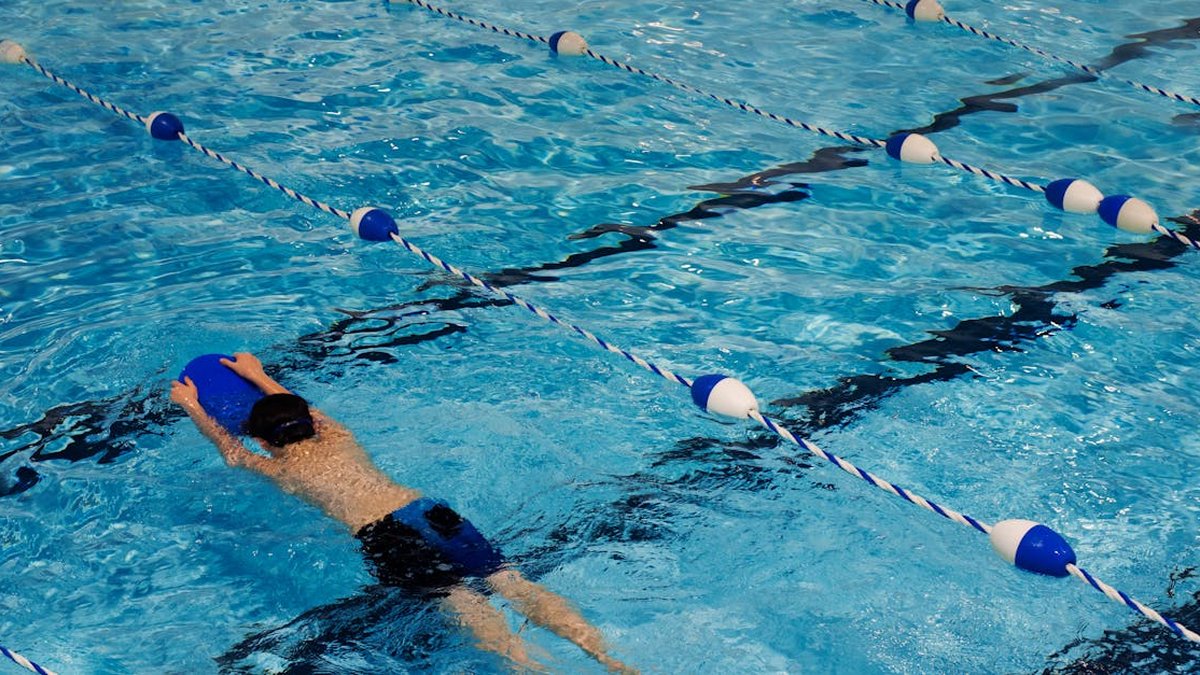
Follow this interval-based plan three days per week. Each session includes a 5-minute warm-up of gentle kicking with a kickboard, followed by 20–25 minutes of main set work, and a 5-minute cool-down of easy swimming. Week 1: swim 4 x 25 yards freestyle with 45 seconds rest between each. Week 2: increase to 6 x 25 yards with 40 seconds rest. Week 3: add 2 x 50 yards freestyle (60 seconds rest) plus 4 x 25 yards backstroke. Week 4: complete 8 x 25 yards freestyle with 30 seconds rest, plus 4 x 25 yards breaststroke kick with board. Track your total yardage each week and aim to increase by 10–15% every two weeks.
Drills to Correct Common Beginner Errors
Most beginners cross their arms over the centerline during freestyle, which creates drag. Fix this with the “catch-up” drill: keep one arm extended forward until the other arm finishes its pull and touches your hand before starting the next pull. For backstroke, the “one-arm” drill — swim with only your left arm for 25 yards, then switch — helps you feel the correct pull path. Breaststroke timing errors often come from rushing the glide. Use the “3-second glide” drill: after each kick, count “one-thousand-one, one-thousand-two, one-thousand-three” before starting the next pull. Perform each drill for 4 x 25 yards during your warm-up or cool-down.
Tracking Progress and Setting Goals
Measure your improvement by recording your time for a 100-yard swim every two weeks. A beginner’s goal is to complete 100 yards freestyle without stopping in under 2 minutes 30 seconds within 8 weeks. Also track your resting heart rate one minute after each main set — a drop of 5–10 beats per minute over 4 weeks indicates improved cardiovascular fitness. Use a waterproof notebook or simple app to log yardage, stroke counts, and perceived effort (scale 1–10). Set a short-term goal of swimming 500 yards continuously by week 6, and a medium-term goal of 1,000 yards by week 12. Consistent practice, not intensity, builds the foundation.
“Most beginners focus on speed instead of efficiency. Slow down your stroke, extend your reach, and use a glide — you’ll swim longer with less fatigue.”
Frequently Asked Questions
Common questions about swimming and water sports
How often should a beginner swim to see fitness gains?
Swim three times per week with at least one rest day between sessions. This frequency allows muscles to recover while building cardiovascular endurance and stroke consistency.
What equipment do I need for beginner swim workouts?
Basic gear includes a well-fitting swimsuit, goggles, and a swim cap. A kickboard and pull buoy help isolate strokes and are often available at pool facilities.
Why do I get out of breath quickly when swimming freestyle?
Breathlessness usually stems from holding your breath underwater. Exhale steadily through your nose and mouth while your face is submerged, then inhale quickly when you turn your head to breathe.
Can swimming alone build muscle mass?
Swimming builds muscular endurance and lean muscle but does not produce the same hypertrophy as heavy weight training. For noticeable muscle growth, combine swimming with two weekly strength sessions targeting major muscle groups.
Related Articles
Start Today
Mastering basic stroke technique and following a progressive pool workout plan will transform swimming from a casual activity into an effective fitness discipline. Focus on form over speed during the first four weeks, use the recommended drills to correct errors, and log your progress to stay motivated. By week 12, you will have the endurance and confidence to swim continuously for 30 minutes.