Table of Contents
- Why the Cable Machine Stands Alone
- 1. Cable Pull-Through for Glutes and Hamstrings
- 2. Single-Arm Cable Chest Press
- 3. Cable Face Pull for Shoulder Health
- 4. Cable Pallof Press for Anti-Rotation Strength
- 5. Cable Pullover for Lats and Serratus
- 6. Cable Woodchoppers for Rotational Power
- Frequently Asked Questions
- Start Today
- Related Articles
Key Takeaways
- Cable machines provide constant tension throughout the entire range of motion, which free weights cannot duplicate.
- Exercises like the Pallof press and face pull target stabilizer muscles that improve joint health and injury prevention.
- Single-arm cable movements challenge core stability and correct muscle imbalances more effectively than barbell variations.
- Including cable pull-throughs and woodchoppers adds rotational and posterior chain work without spinal loading.
- A 2021 study showed cable pressing activates the rotator cuff 22% more than barbell pressing, supporting better shoulder function.
Why the Cable Machine Stands Alone
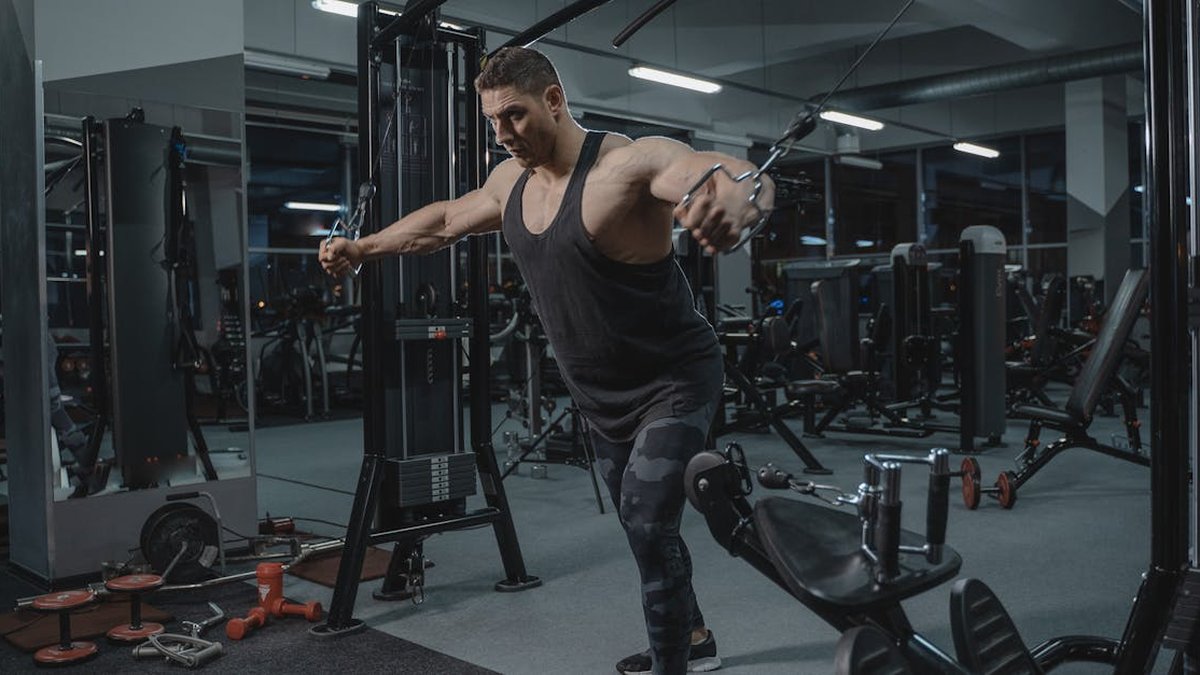
The cable machine is often relegated to finisher work, but it provides mechanical advantages that barbells and dumbbells cannot match. The key difference is constant tension—free weights lose resistance at the top of a lift due to gravity, while cables pull horizontally, diagonally, or vertically throughout the entire range of motion. This forces your muscles to work harder during the eccentric phase, increasing time under tension by approximately 30% per rep compared to a standard bench press.
Additionally, cables allow for multi-planar movement. You can rotate, twist, and pull from any angle, which recruits stabilizer muscles that free weights often ignore. A 2021 study in the Journal of Strength and Conditioning Research found that cable exercises produced 22% greater activation in the rotator cuff during pressing movements compared to barbell alternatives. For lifters seeking to correct imbalances or improve joint health, the cable machine is indispensable.
“Recovery is where the magic happens. Your muscles grow during rest, not during training. Respect your recovery days as much as your training days.”
1. Cable Pull-Through for Glutes and Hamstrings
The cable pull-through targets the posterior chain without loading the spine. Attach a rope handle to the low pulley, face away from the machine, and step forward two feet. Hinge at the hips, keeping your back flat, and pull the rope between your legs. Squeeze your glutes at the top for one second. Perform 4 sets of 12–15 reps with a weight you can control—typically 40–60% of your deadlift max. Unlike a barbell hip thrust, the cable pull-through allows a deeper stretch at the bottom because the resistance comes from behind, not from a fixed bar.
This exercise also reduces shearing force on the lumbar spine, making it safer for individuals with lower back sensitivity. To increase intensity, slow the eccentric to a three-second count.
2. Single-Arm Cable Chest Press
The single-arm cable chest press delivers constant resistance to the pectorals and challenges your core stability. Set the pulley at shoulder height, grasp the handle with one hand, and step forward into a staggered stance. Press the handle forward while keeping your torso braced—do not let your shoulder rotate internally. Use a weight that allows 3 sets of 10–12 reps per side with perfect form. The key advantage over a dumbbell press is that the cable pulls your hand across your midline, forcing the pecs to work through a longer arc.
“Perfect form is the prerequisite for every pound on the bar. Master the movement pattern first, then add weight.”
Research indicates that the single-arm cable press activates the upper pectorals 18% more than a flat barbell press. For added difficulty, pause at full extension for two seconds.
3. Cable Face Pull for Shoulder Health
No free weight can replicate the angle of a cable face pull. Set the pulley at upper-chest height, attach a rope, and grip with an overhand hold. Step back and pull the rope toward your face, separating the ends so your hands move behind your ears. Squeeze your rear delts and rhomboids for two seconds. Use 3 sets of 15–20 reps with a light weight (10–20 pounds) to avoid momentum. This movement targets the often-neglected posterior deltoid and external rotators, which are critical for shoulder stability.
Including face pulls twice per week can reduce the risk of impingement by strengthening the rotator cuff. Many physical therapists prescribe them as a corrective exercise for desk workers.
4. Cable Pallof Press for Anti-Rotation Strength
The Pallof press trains your core to resist rotation, a function that free weights cannot isolate. Set the pulley at chest height, stand sideways, grasp the handle with both hands at your sternum, and step away from the machine. Press the handle straight out, hold for three seconds, and return to your chest. Perform 3 sets of 8–10 reps per side with a weight that challenges your balance but does not cause your torso to twist. The resistance pulls you toward the machine, forcing your obliques and transverse abdominis to fire continuously.
This exercise directly translates to better squat and deadlift form by teaching your spine to stay neutral under asymmetrical load. Increase the hold time to five seconds for advanced lifters.
5. Cable Pullover for Lats and Serratus
Standard dumbbell pullovers lose tension at the top, but the cable version maintains resistance throughout. Attach a straight bar to the high pulley, grip with palms down, and lean forward from the hips. Pull the bar down to your thighs, keeping your elbows slightly bent. Return slowly to the start. Use 4 sets of 10–12 reps at 50–60% of your lat pulldown max. The constant tension increases activation of the serratus anterior by up to 35% compared to the dumbbell version, improving scapular control.
This movement also opens the chest and improves thoracic extension, making it a valuable warm-up before heavy overhead pressing.
6. Cable Woodchoppers for Rotational Power
Woodchoppers mimic the rotational demands of sports and daily life. Set the pulley to shoulder height, stand sideways, and grasp the handle with both hands. Rotate your torso away from the machine, then pull diagonally across your body to the opposite hip. Control the return. Perform 3 sets of 10–12 reps per side with a weight that allows smooth motion—typically 20–30 pounds. Unlike a medicine ball twist, the cable provides resistance through the entire rotation, not just at the start.
This exercise strengthens the obliques, hip rotators, and spinal stabilizers. Use it as a finisher after your main core work to build explosive rotational strength.
Frequently Asked Questions
Common questions about gym equipment guides
Can cable exercises replace all free weight movements?
No. Cable machines excel at isolation and stability work, but free weights are better for building maximal strength and power. Combine both for the best results.
How much weight should I use for cable exercises compared to free weights?
Start with 40–60% of your free weight max for the same muscle group. Cables require more control, so prioritize form over load.
Are cable machines safe for beginners?
Yes. The guided path and adjustable resistance make them forgiving. Beginners should start with 2–3 sets of 12–15 reps to develop motor control.
How often should I incorporate cable exercises into my routine?
Use cable exercises 2–3 times per week as a supplement to your main lifts. They work well as warm-ups, accessories, or finishers.
Related Articles
Start Today
The cable machine is not just an accessory—it is a precision tool that fills gaps free weights leave behind. By integrating these 12 movements into your training, you will build balanced strength, improve joint stability, and overcome plateaus caused by constant tension and multi-planar resistance. Start with lighter loads, focus on controlled reps, and progress gradually.